Tuesday, May 30, 2017

VIETNAM GLOBAL HEALTH -- VISITING ST. PAUL HOSPITAL


After we visited the injection molder, we then visited St. Paul Hospital, a provincial hospital located in the heart of Hanoi.  Though we are targeting district hospitals – which are typically smaller and have fewer resources in terms of staff, funding, and capabilities – our interview with doctors from St. Paul was fruitful.  We received two validating responses to the user experience around Otter’s interface, which we have been working throughout this past semester.  (Upon asking Dr. Duong Nguyen to set the temperature to 33 degC, she pressed the buttons and then shot us a glance that said, “Is that it?”)


Elizabeth Johansen (ADE Advisor), Nurse Bach (St. Paul Hospital), and

Dr. Hanh Nguyen (St. Paul Hospital) try the Otter prototype interface.


We also began formulating a clearer picture of medical need around Otter used in conjunction with Firefly phototherapy, our primary use-case. To better uncover this information, we created a new prop nary an hour prior to the interview: the patient flipbook.  The patient flipbook allows us to quickly ask healthcare workers about which equipment they would use with a variety of patients with jaundice by highlighting four characteristics: gestational age, weight, core temperature, and jaundice severity.  There is a range per characteristic (ex: mild jaundice to severely jaundice), again – allowing us to quickly cover a broad range of patients and their hypothetical journeys.


Flipbook to explore the best warming & phototherapy devices for different newborns.

Dr. Hanh Nguyen (St. Paul Hospital), Liani Lye (ADE), and Hoa Dang Thanh

(MTTS translator) use the patient flipbook at St Paul General Hospital.


Though these are two positive takeaways from our interview, we must retain team- and project-awareness as we progress through the trip.  We must remember to always validate with our target market in mind; demand at a single provincial does not equate to blanket demand at district hospitals.  And, we should continuously balance streamlining our interview process against eliminating interviewing bias and answering many project questions thoroughly.  Forward and onwards!

VIETNAM GLOBAL HEALTH - VISIT TO AN INJECTION MOLDER

We started our first day in Hanoi with a trip to a local mold maker & an injection molding contractor. The goal was to investigate their facilities and estimate the likely cost of manufacturing our plastic user interface housing for the Otter newborn warmer. The photo below shows the team attaching the white, plastic user interface to our warming bassinet.


How many engineers does it take to drill a hole? Answer: Chloe Nguyen (MTTS), Hoa Dang Thanh (MTTS), Maire Keene (ADE) and Liani Lye (ADE).
There are many options for how to make a plastic part. As the quantities increase, injection molding can become a cost-effective way to make many identical parts with complex geometries. Design that Matters’ manufacturing collaborator, MTTS, suggested a vendor nearby in Hanoi might be able to make our part for an affordable cost.

At the mold-making shop, we spoke with Lai Duc Khoa who reviewed our CAD model and the 3D-printed part we made. We learned about the importance of working with manufacturing vendors close to MTTS in Hanoi to better ensure quality and keep costs like importation fees low leading to lower part costs.

Chloe Nguyen (MTTS Engineering Fellow) translates our questions for Mr. Khoa, a potential plastic injection mold-making vendor.

Duc (MTTS) and Maire Keene (ADE) standing near the CNC machines that make injection molding tools.
The mold maker uses CNC (computer numeric control) machines to create the mold; negative impressions of the inside and outside of a plastic part. The mold for our part would likely be made from steel. This vendor would then give the mold to a subcontractor. To create a plastic part, the subcontractor would fit the mold inside a press that holds the two pieces together while hot, liquid plastic is injected into the cavity formed by the two pieces. We visited one of the sub-contractors who was using one of the molds to create a Mickey Mouse toy.


The negative and positive sides of an injection mold for a mickey mouse toy!

Extra pieces of plastic such as the gate are trimmed from the toy by hand.
It looks like these vendors could be a good option for molding our part. The price estimates are a little higher than we planned, but would only add a few dollars to the price tag of our medical device.


Many thanks to Nguyen Duc Viet, MTTS Mechanical Engineer and Chloe Nguyen, MTTS Engineering Fellow, for setting up this visit, providing insight on how to select a vendor, and for bridging the language gap.

Author: Maire Keene

Food Processing - Central market in Kumasi


Day 3:
Today is a national holiday, the united African holiday, so the shop at ITTU is closed. In the morning we did some documentation and drawings work, and then walked from our hotel to the Engineering Guest House at KNUST, where Ben gave a talk about ADE and IDIN founding to a group of IDIN members. 

After the talk, we headed to the Kumasi central market to buy some fabric to make some custom clothing from a trusted Ghanaian seamstress! Ghanaian women have a great sense of fashion and the majority wear custom clothing from colorful fabric. Each day on the commute from our hotel to ITTU we see a fashion show just by looking outside on the street.

The central market sold everything you can find at a big grocery store and a shopping mall, but in the open air with small "ground stands". People flowed constantly through the narrow alleys like traffic. Women holding bowls of things on their heads, and saying Ago, Ago to you if you don't move. 

Sellers selling vegetables and soap/detergent, next to each other
There were at least 4 alleys of fabric sellers, and the variety of fabric are all so colorful and beautiful to make a choice very difficult.

Fabric shop with a woven type of fabric that is expensive 

Fabric alley full of color 

We decided to buy some batik fabric, a special soft fabric that is patterned by wax and also some block printed ones. 
Tomorrow will be another full day of work at ITTU, then we are excited to visit community villages during the weekend! 

Thanks for reading :) 

Food Processing - Welcome to the shop!

Day 1
Today is our first day working at ITTU! After a good breakfast of whole wheat toast, egg pancakes with scallion, tea and Milo chocolate energy drink, we met our program manager here in Ghana, a female engineer who studied agriculture engineering at KNUST. She hugged each of us and welcomed us with her stunning smile. It took us about 30 mins to drive from our hotel to ITTU (short for Intermediate Technology Transfer Unit), located in the Suame Magazine area, where metal workers and car mechanics are concentrated in a village. ITTU is a KNUST machine shop that produces and assembles our machines. On arriving, we met all of our partners who help us fabricate the machines there. Their open friendliness and happiness to see us made all of us smile. It felt like they have already known us because we work on the same project, even though most of us have never met before, and we started meaningful conversations right away.
The entrance to ITTU in Suame Magazine

Then, we started work by making a list of technical and business tasks as well as planning a community visit.
Then, after lunch we assigned tasks to each of us and started on some of them. The business team discussed updating pricing of the machines and the customer relationship management system. The technical team started unpacking all of the tools we brought from the US, as well as press fitting some bearing adapters into bearings using the local press, and asking a senior ITTU fabricator to broach more inserts.The plan for tomorrow is to build a reference machine for a new grater design. With all of the new fixtures, we can speed up this process substantially.

            The fixtures, parts and tools we brought to Ghana with us all unpacked

Day 2
Today we made lots of progress on both the business and tech side. The business students discussed a plan to incorporate in Ghana and a potential funding partnership to support the machine owners. They also finished updating the Customer Relationship Management (CRM). The tech team trained the fabricators at ITTU to use the templates and newly designed features. They also debugged the broaching method for bearing adapters and tried a new method. We also explored the basement space downstairs that we want to move into. 

In the afternoon, we were distracted from work by a variety of local food, brought by women who carried them on their heads. First we had mangos grown at our shop manager’s house and ball fruit (fried dough in the shape of a ball), then we drank juice from an entire green coconut and also ate the fruity inside. One of our partner fabricator also offered us his daily snack, a local specialty: tiger nuts that taste like coconut but looks like peanuts.

One of our partner fabricators, holding a bag of sweet peanuts that he offered to us to try


Saturday, January 14, 2017

Food Processing -- Mah Krow from Ghana!

Day 12:

Today started early at the SMS Guest House. We packed up all of the tools and parts we will be bringing back to Boston, along with some old machines for archiving, and started the 3 hour van ride back to Accra. We stopped along the way to visit and check in with two customers.

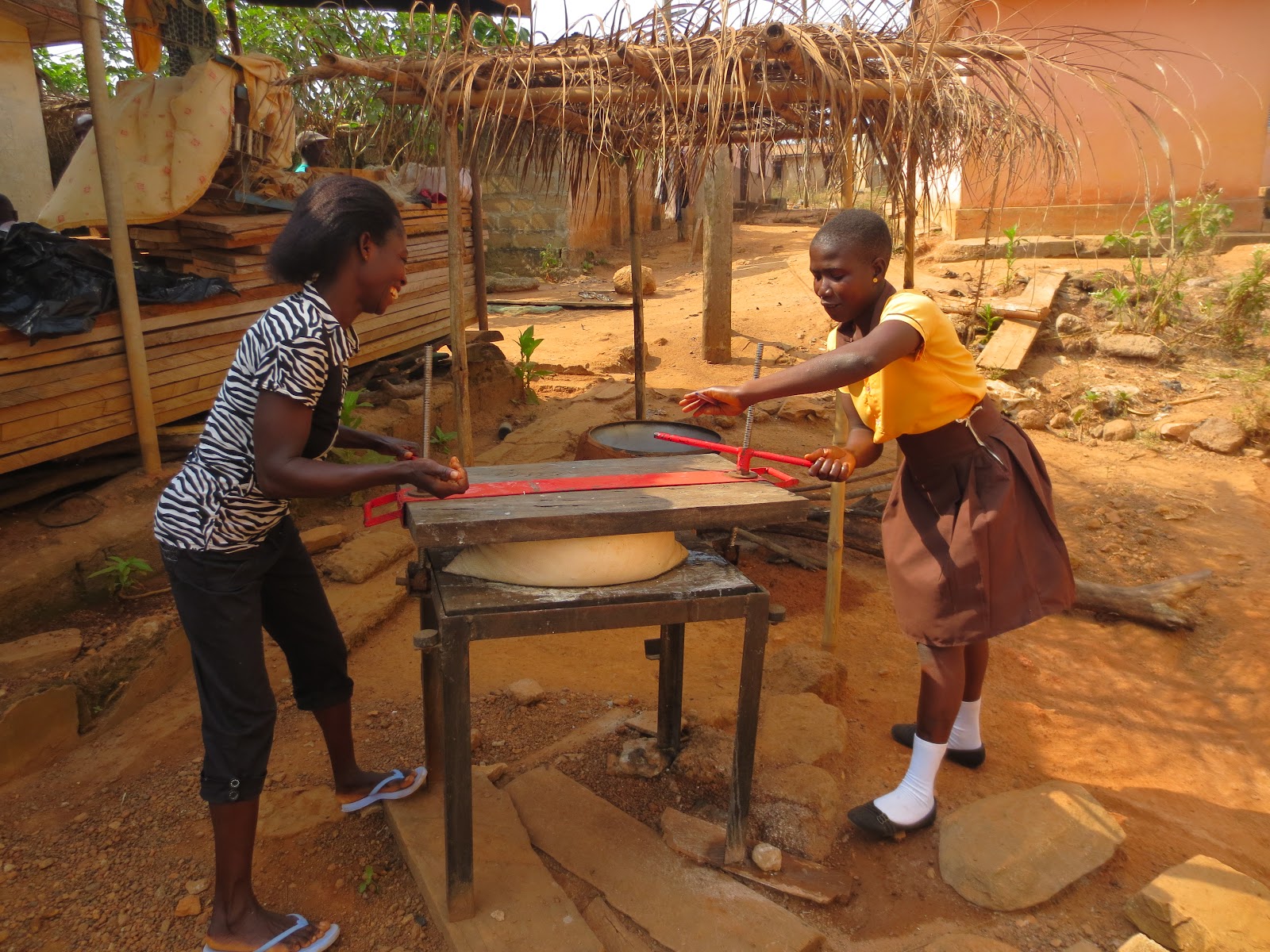
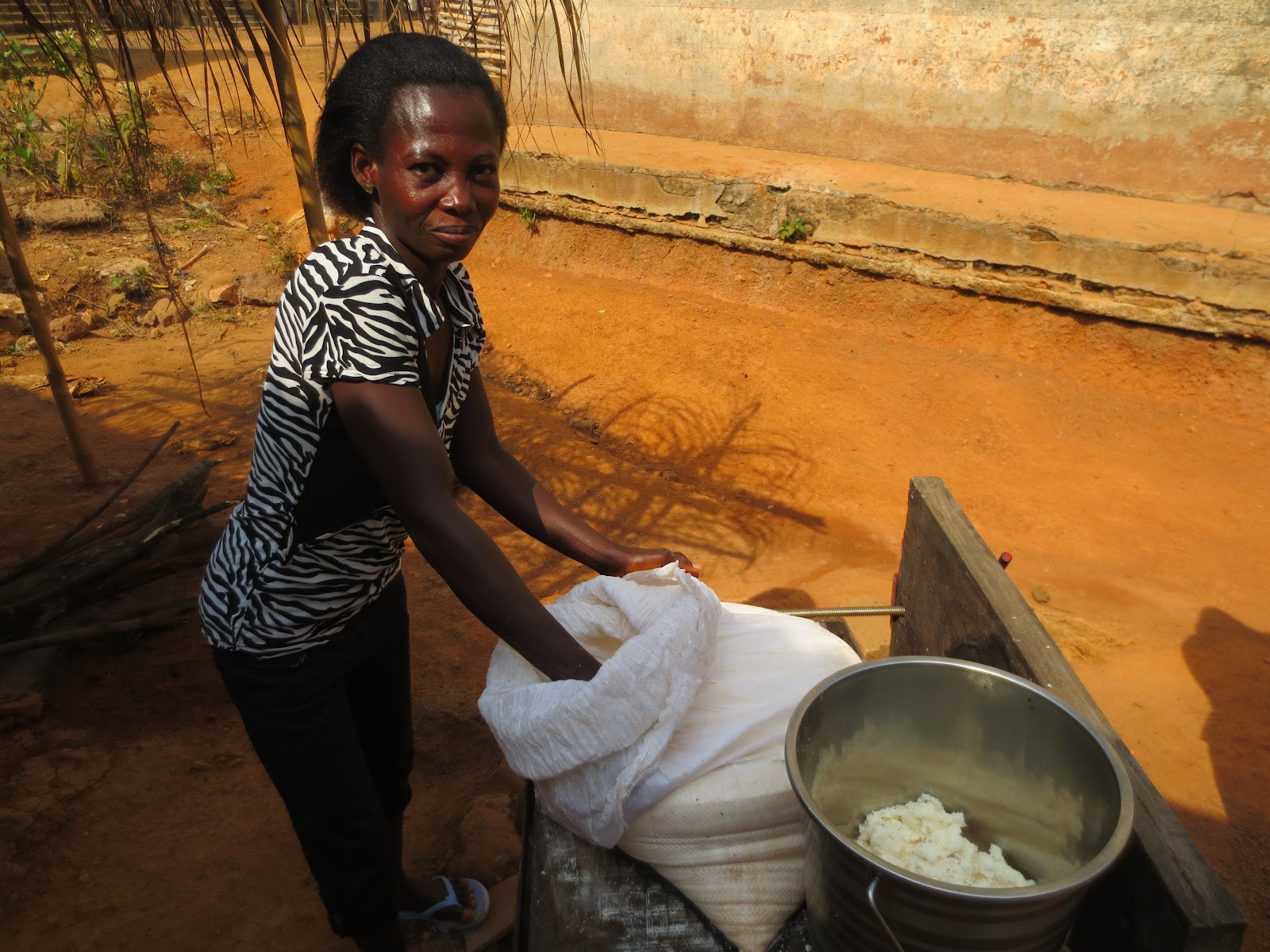
Drying grated cassava with an older QueenTech press

Getting ready to toast some gari

In the evening we met up with an importation agent that had been recommended to us by a friend of the venture. We had a productive conversation, and we are very optimistic that he will be able to help us resolve problems we have been facing with getting our grater motors from China to Ghana. Since this is a supply chain issue that could seriously impact our production schedule it is a huge relief to have made forward progress, especially as our time in Ghana winds down.


We have two more days in Accra before we leave for Boston on Sunday, which we will be spending finishing up trip documentation, identifying and prioritizing tasks for next semester, and getting to see some of the city.

Thank you for joining us on this exciting journey and continuing to support the ADE program. See you in May!


This goat posting sanctioned by Ben Linder

Friday, January 13, 2017

India - Child Education - Learning Through Experiencing

Our first observation of the Brightbox was in a class conducted at Agastya. Students from a nearby school came to campus for an hour long lesson on light using Brightbox. A group of about thirty 14 year old girls with matching braids walked into the physics teaching lab at Agastya. We waited in anticipation at the back of the classroom while their teacher divided them into groups and demonstrated the Brightbox. As each exercise was handed out students worked intently. The students were so focused on finishing the exercise that they rarely spent time just exploring or playing with the Brightbox. Now we have observed three class sessions and noticed this as a fairly common thread. We were expecting much more discovery time and play with the Brightbox to help spark the children’s curiosity beyond the initial lesson.

However, we found a different experience when visiting a night school program called Operation Vacenta. The goal of Operation Vacenta is to provide village children a place to learn, do homework, and explore new subjects while their parents work in the evenings. While the Agastya classes took place on the clean, fresh campus, the night schools were typically one room or open-air classrooms in the hearts of local villages. The smells of food, nature, and other things were all around us, and the students were very different than those we met in class. These students ranged in age from four to sixteen, and did not have the educational experience of some of the students on campus. On our first visit to night school, students demonstrated the different activities they do there, performing songs, dances, and dramas. Of course, we had to reciprocate the act, and performed several of our own numbers, such as “itsy bitsy spider” and “head, shoulders, knees and toes.” We learned that the environment at night school was not as structured, especially because there were young adult volunteers rather than formal teachers. The leader of the local night schools, Madame Jayama, invited us to bring Brightbox to night schools the next day.          

We started our lesson off by giving each group of students time to explore and play with the different lenses, prisms, and mirrors included in the Brightbox optics kit. Each group was given flexibility to take as much time as they wanted. This was very important in allowing each group to understand some of the principles of the lenses. By giving each group a mentor who could answer questions and encourage exploration, children were able to understand and explore more than in a strongly structured routine. After some time, each group started and finished a new exercise we developed. They seemed to have a lot of fun doing it including lots of giggles and creating their own puzzles. We thought it was really great that the teams did not seem to get bored, but instead kept playing once the lesson was done. We considered the night a success, as the curriculum we had worked, and left the kids interested and excited.

When we realized that we would be conducting our next lesson at the night school with the same group of students, we struggled to create new curriculum in the hours before. None of our demos were working and we went to the night school with a list of short exercises rather than a coherent lesson plan. We were prepared for the lesson to be chaotic, however halfway through the lesson we realized that our lack of preparation was the most serendipitous mistake we could have made. 
Because we divided the groups by age, some of the groups worked at very different paces. The group of eighth graders had long since finished the first exercise by the time the youngest students successfully finished. After the oldest students solved the puzzle they began exploring other ways to play with the Brightbox, coming up with activities that were much more interesting and creative than what we could have thought of in a classroom at Olin. For example, the students working with Nick focused the elephant image to a point so that it could be passed through a slit, then diverged the point to project the elephant onto a sheet of paper. I guess they figured out how to pass a giraffe through a needle’s eye! Students at the other night school noticed that they could project the light onto the ceiling and soon created their own activities making the elephant images dance and compete with each other. Meanwhile, the younger students had the time and intrinsic motivation to continue working on the first exercise until they were fully satisfied with a solution. This is the kind of grit that the latest pedagogical theory has only just started to recognize the importance of.

While a lack of structured instruction allowed the students to become immersed in the experience, one night school volunteer made us realize the importance of some lecture. He walked over to a group of students who had just solved a difficult puzzle. Although they were giddy with their victory, the real transformational moment happened when their teacher explained why their solution worked using optics concepts. When he pulled in examples like movie projectors and rearview mirrors, the room was filled with “ohhh!”s The Brightbox set the stage for insights, but the teacher led them to the “aha” moment.

Having the opportunity to observe some of Agastya’s many use cases for Brightbox gave us insight into what kinds of environments do and do not suit Brightbox. We realized that the lack of structure in the night school allows for the kind of exploration that makes Brightbox fun. Based on what we learned, we plan to adjust the curriculum of the Brightbox to build in exploration time and an explanation at the end of the lesson even in the more traditional class setting.

Thursday, January 12, 2017

Food Processing -- Closing Up Shop

Day 11:

Today was a very hectic but immensely satisfying day. It being our last day at ITTU, we knew we would have to scramble to finish everything we wanted to get done. After an intensely busy 10 hours in the shop, we hit our mark.

Working around the herd of electricians that has become a fixture at the shop, the team split up to conduct our remaining trainings. This involved cutting and bending all of the sheet metal parts of the grater and using our newly-designed jigs and fixtures to assemble parts quickly and accurately. Using our friend’s electricity again, we were able to keep our spot welder and chop saw online for the entire day. The ITTU fabricators picked everything up quite quickly, asking salient questions and making suggestions along the way.

Moving the chop saw in search of electricity

Welding a grater handle using a jig

Checking the fit on the new anvil

ITTU fabricators working on a new plunger

One benefit of running so many trainings is that we were able to produce a full grater in a single day. This new machine, built almost entirely by the ITTU fabricators and dubbed “the best grater we’ve ever made” by the team, will be kept in the shop as a reference. All new components that are produced will be checked against this machine, meaning that we will create parts that are interchangeable between machines. This hugely simplifies any service we may need to perform on deployed machines, and is a very important step forward for the pilot study. Instead of making a few machines at a time, we are moving quickly towards a more sustainable and scalable production model that will allow the venture to grow in the coming months and years.

Welding the legs onto the grater

Final assembly and transmission alignment

We owe a huge thank you to our partners at ITTU for their patience during these past few chaotic days and their willingness to go the extra mile, working into darkness today to finish our last few tasks. We will be sad to say goodbye to Kumasi tomorrow as we head back to Accra, but are looking forward to tackling some critical business challenges in the next few days that have so far taken a backseat to technical work.


The completed reference machine