Monday, January 14, 2019

Tuesday, June 19, 2018
Food Processing - The First Few Days
Day 2:
Yesterday we arrived in Kumasi in record time and met Debbie and Asanti at TCC. After a good night’s rest, we arrived at ITTU this morning to lay out the major goals and tasks for our trip. We plan to sell more of the current press design, finalize the new press design, get NGO status, secure more funding, and improve general and long-term maintenance for our machines in the field. We also want to sell new handles for our existing presses to improve their reparability and longevity.
The tech team got to work cleaning our existing presses with our new angle grinder to get them ready to sell. We worked on optimizing our new press design that will allow us to eliminate one of the lead screws, the largest chunk of the cost of the current design out in the field. The business team worked on pricing and stock to make our new handles and a prototype of our new press design. We need to hustle to get everything finished for our community visit this weekend.

We cut a lot parts for the new press builds and handles.
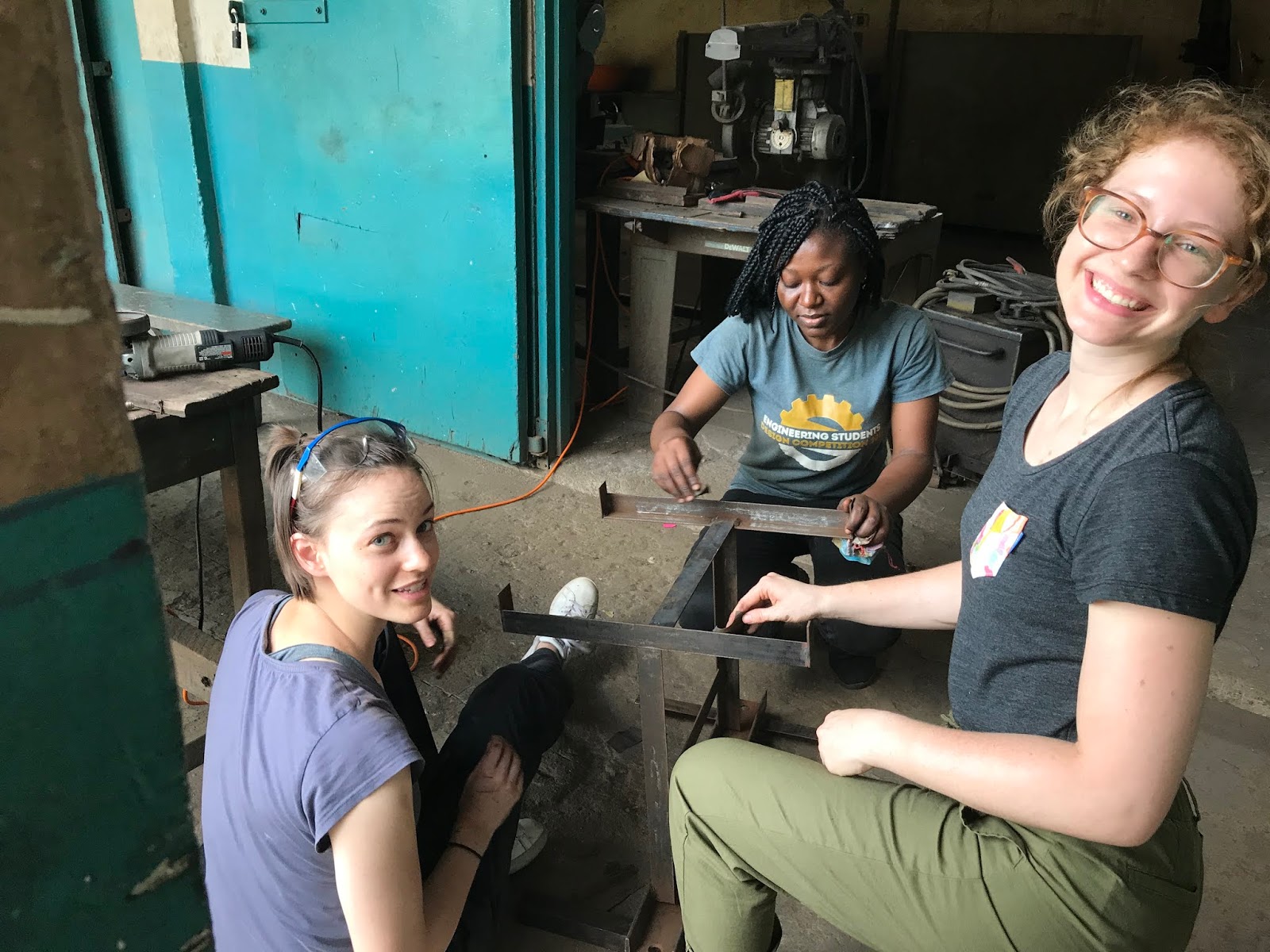
There was some sanding to do on previously-built presses so they are ready to be painted.

We welded our newest prototype so we could test it.
Day 3 (morning):
 Today we really got down to business. We finished QueenTech’s constitution that is necessary to become an NGO. We tested some different handle designs to find out what would be the best balance between being comfortable to use and hard to over-torque to protect the lead screws. We don’t expect all of our operators to buy new handles if theirs have yet to wear out, so we’re only bringing a few pairs to sell. The women that don’t buy them will be able to test them and will know to buy them once their handles wear out.
The picture to the left shows our painting set up. We are now able to do all of our painting at ITTU.
Wednesday, January 17, 2018
Food Processing - Visiting the Communities
An
important part of our trips is visiting the women who use our machines to process
cassava to make gari to sell to their local communities. We currently have 30
machines (graters and presses combined) out in the field, which requires a lot
of upkeep as we continually learn more and change our product designs. It is
important for us to understand the condition the machines are in so that we can
iterate future designs based on what we learn on both the condition of the
machines and how the users interact with them.
We also want to continue to build our relationships with our operators,
especially those who have been with us for many years and have taught us a lot
about our venture and products.

Meeting with old friends
We
visited three different villages near Konongo: PKK, Adukrom, and Domeabra.
Though plans changed and our original schedule went out the window, we
completed our main objectives of the trip: repair and upgrade machines,
understand the status of our many stakeholders, co-design and get feedback, and
deliver funds.
In all, we repaired and upgraded 11
machines. Although we thought we knew what kinds of repairs to expect, what we
actually saw in the field was a bit unexpected. We faced some challenges
working with the equipment and parts we brought making sure that we would be
able to repair all of the machines we could so that no one would be left with
an unusable machine. We were able to fix a few machines prevent others from
wearing down in the future.

Stick welding on the press to strengthen its feet and keep it from
wobbling

Replacing and upgrading bearings on a grater
Follow up with our users is very important
to us to make sure that we are making a positive impact and to better understand
our user group when we want to implement new procedures, products, or other
materials. To do this, we met with our stakeholders to interview them about
their experiences with the machines and their businesses, get feedback on logo
ideas, discuss warranties, and co-design training manuals. It was very valuable
to get their feedback and see them interact with the material we provided. For
example, one woman could not easily see the training material. If bad eyesight
is common, it is likely that other women we sell machines to will have
difficulties seeing the training materials as well. This is just one example of
the many insights we gained while meeting with the operators.

Discussing training materials

The
team after a long day
Our last goal of the trip was to
visit three women and deliver great news. Because of our work this past
semester with Womentum, a crowd funding site for women entrepreneurs in
developing countries, we were able to deliver the money to the women who
received funding. Each of the women received money towards their cassava
processing businesses.

Women who received money through Womentum for their cassava businesses
Although it was a lot of work
squeezed into two days, seeing the smiles on the operators’ faces when we fixed
what was broken and hearing things like “the gari from this machine is perfect”
made me really understand how meaningful our work is to the women, their families,
and their communities.
I will leave you with a picture of
a goat riding on top of a van travelling about 40mph in heavy traffic.

Sunday, January 14, 2018
Who are the Families Otter Might Touch?
A central tenant of ADE and the Otter project is to continually strive to understand context and stakeholders. We have done a lot of co-design work with healthcare workers, but that is not the whole picture. On this trip we wanted to meet and learn about those who arguably are most impacted by Otter: the patient and parents.
On the second day of our time in Vietnam, we visited Nam Dinh Provincial Hospital. Our contact at Day One Health, the amazing Hoi who also translates on our trips, arranged with the hospital for us to meet a family who would be taking their child home on the day we visited. The plan was that we would get to speak with the family before giving them a ride back to their home. Unfortunately the day we were visiting was day 23 in the local calendar and no families wanted their children discharged because it was not considered a lucky day. We were able, though, to meet Luu Van Thuoc (father), Ngo Thih Luot (mother) and Luu Van Thao (baby) at the hospital.
On the second day of our time in Vietnam, we visited Nam Dinh Provincial Hospital. Our contact at Day One Health, the amazing Hoi who also translates on our trips, arranged with the hospital for us to meet a family who would be taking their child home on the day we visited. The plan was that we would get to speak with the family before giving them a ride back to their home. Unfortunately the day we were visiting was day 23 in the local calendar and no families wanted their children discharged because it was not considered a lucky day. We were able, though, to meet Luu Van Thuoc (father), Ngo Thih Luot (mother) and Luu Van Thao (baby) at the hospital.
 |
| Luu Van Thuoc, Ngo Thih Luot, and Luu Van Thao with team adviser Elizabeth and Hoi from Day One Health |
Thuoc
and Luot are farmers and seasonal workers who live about 50 km away from Nam
Dinh. The couple’s previous four children were born at a local community health
center, a “chik-jum”, which is the lowest rung on the Vietnamese health care
ladder. Luot is 44 and knew Thao would be a high risk pregnancy and that she
would likely have to give birth in a hospital.
The
night before Thao was born, Luot experienced a pain in her stomach. Not wanting
to travel the 50 km to Nam Dinh at night, she decided to wait until the morning
before going to a closer district-level hospital. At the district hospital, the
doctors told her she had hypertension and that she must go to the Nam Dinh
emergency room. At Nam Dinh, doctors
determined that Thao was not doing well and needed to be immediately delivered
by C-section. Luot was told the priority was to save her life. For her, this
was “the scariest moment”.
Thao
was born with respiratory complications. Thuoc and Luot were told of their
child’s condition, but the details and treatment plan were not shared. They
were also only allowed to see Thao once during the hospitalization. Since the
NICU is so small, parents cannot stay with or visit their children. The hallway
outside is also crowded, so parents cannot even look through the window into
the NICU. Luot stayed at the hospital the entire time, however, to provide
breast milk which nurses bottle fed to Thao. Mothers at Nam Dinh are given a
bed to use for this purpose during their infant’s hospitalization.
 |
| The team with Thuoc, Luot and Thao |
After
fourteen days in the hospital (we spoke with Thuoc and Luot on that 14th
day), Thao was healthy enough to be discharged. The excitement and relief of
parents preparing to take their newly healthy child home for the first time is
infectious and it was incredible to get to share that joy with
this beautiful family. As we continue to design Otter, we are looking forward to helping other families bring home healthy newborns.
Friday, January 12, 2018
Food Processing - First Few Days
Day 2:
We arrived in Ghana yesterday after
a delayed flight from the weather at JFK. Unfortunately upon arrival we found
that a good portion of our checked luggage was never loaded on the plane and
was still in New York. Our late arrival and lost luggage lead to a change of
plans, but we always make a goal of staying flexible on our trips, so when we arrived
at ITTU today, we got to work and started our planning for the rest of our stay. We plan to
shoot and co-design training materials, open bank accounts, fix machines in the filed, and start our
production up and running again (which means we’re on the hunt for a new
motor!).
In the
afternoon, we started the hunt for a new motor after asking for leads from ITTU’s
manager. This was our first exploration out into Kumasi. Everything is sold in
shops that specialize in unique products. We went to four different shops that
sell air conditioner motors to track down what we wanted. Unfortunately,
finding a motor the correct size was even more difficult than I originally
imagined. Most of the motors were much too small (Ghana has a lot of air
conditioning, but it is mostly single room units). Although we did not find
what we needed on the first try, I think we will eventually find what we want. Where
there’s a will, there’s a way.
Day 3:
Today was
filled with so many things. Both the technical and business teams were kept
busy with brainstorming ideas for logos, working on the training manual,
sourcing motors, making new bearings, and planning for our trip to the
villages.
On the
technical side of things, we made some new bearing assemblies with bearings we
brought with us. Unfortunately the bearing inserts compressed when they were
pressed in, so we had to rebroach them. Machines at ITTU are much older than
the ones we are used to at Olin. The arbor press was quite awesome (I had never
seen one like it before), but not quite suited for the application we wanted as
it is too short for our broach and parts to fit. Despite this, we were able to
make it work, though we found out first hand that we do not want to continue
with this manufacturing method.
We also
made a surprising insight about our wooden heads. We want to switch from
plastic to wood for our heads to save on costs, so we tested a few things last
semester about the wooden heads. When we arrived at ITTU, we found that one of the wooden heads made on the last trip had shrunk so much that the metal tooth sheet came off. We think that it is because the
heads were made in the wet season, and we are now in the dry season, so the
moisture content of the wood has dramatically decreased. This is something we
will be investigating in the future.

Washing cassava for the training video.
 On the business side of things, we
are working on training materials, which are very important to making sure our
machines do not break in the field. A major cause of our graters and presses
going down is from improper maintenance and cleaning. To mitigate this, we are
working on training manuals and videos. Today, with a grater, some cassava, and
a makeshift tripod we filmed a practice video showing how to properly grate cassava
and clean the machine.
On the business side of things, we
are working on training materials, which are very important to making sure our
machines do not break in the field. A major cause of our graters and presses
going down is from improper maintenance and cleaning. To mitigate this, we are
working on training manuals and videos. Today, with a grater, some cassava, and
a makeshift tripod we filmed a practice video showing how to properly grate cassava
and clean the machine.
During the filming, we were met by
college students participating in the Innovate Ghana competition who came to
visit ITTU. It was exciting for them to see college students doing similar
projects and what is possible if you care about something so much. It was especially
awesome to see Debbie (our CEO) interact with students not much younger than
herself striving to be entrepreneurs and make change in Ghana like she is.
Debbie said that women are not known to run
machines or be entrepreneurs, let alone start a machine company. She is now a
role model for other young people, especially women who want to make a difference
in Ghana.. We look forward to seeing QueenTech grow and develop over the next couple of weeks and meeting the people we are directly impacting.
Vietnam Global Health - Visit to Samaritan's Purse
On Friday January 12th
our team had the pleasure of visiting Samaritan’s Purse’s Vietnamese office where
we met Emily Arneson, health and nutrition program manager, and Matt Swenson, the
director of SP’s Vietnam programs. SP is a Christian NGO focused on emergency
relief and disaster response. Their long term focus in Vietnam surrounds
maternal/child health (malnutrition), training (of birth attendants),
agriculture, and working with the healthcare system.
All of SP’s work in the country
is in partnership with the Vietnamese government: “The government is always
here so in some ways the partnership ensures continuity” (quote from Emily
Arenson). Their projects mainly begin following government requests for
assistance, which also imposes staff and monetary limitations on their work.
One example of an approach was the donation of MTTS’ medical equipment to Quang
Nam Hospital. The Quang Nam People’s Committee approached SP about a medical
equipment donation, and the organization then researched devices and sought
headquarter budget approval. For each device the procurement team needed to
quote at least three different brand options. Some of the metrics for choosing
devices mentioned by Emily were: durability, including warranty and service
plan; ease of repair; total cost of ownership; training; price; and contextual
understanding. MTTS devices were chosen largely because of their price, quality,
and location – supporting local manufacture was an important additional means
of generating impact through this project.
 |
| Presentation of the Otter to Emily Arenson. |
 |
| Demonstration of Otter functionality. |

When asked about issues
surrounding their work, Matt mentioned that tracking impact was the hardest
part, and that they wanted to devote more thought to questions like: “what are
we doing, is it effective? Useful? Impactful? Do our activites bring about the
change we envision?” I find these questions to be very important. They should
be kept in mind throughout the development of Otter to ensure that teams
remember what it is we are working towards. Overall, it was incredible and
inspiring to hear such experienced humanitarians talk about their work and
vision.
 |
| ADE team, plus Hoi and Hai of MTTS, outside of Samaritan's Purse office. |
Thursday, January 11, 2018
The Key to Designing a Successful Solution: Listen to Your Stakeholders!
Written by Nicole Ciavola
“... it will save the patient money…” said the nurse at Ha Nam, a provincial hospital in Vietnam. My ears perked up immediately because I had been waiting for an insight into what our stakeholders, NICU staff at low-resource hospitals, cared about most. I was there to learn what they needed, what they wanted to accomplish, and how they measured that progress.
The question of how to identify and solve customer needs is the single most important question in entrepreneurship. The product or service a business is offering must solve a real, present problem for stakeholders if a company wants to create value. Unfortunately, many companies allow their focus to drift and instead prioritize making a snazzy product, courting donations, or any myriad of distractions. If you want to create a solution that will make a real difference in the lives of your stakeholders, you must listen to and understand their needs.
Understanding customer needs can be made more applicable when you look not only at what problem your customers are trying to solve, but how they measure the progress. Professor Ben Linder, one of the professors for Affordable Design and Entrepreneurship, a joint course between Olin College, Babson College, and Wellesley College, brought this concept to my attention. The course enables students to work on a social entrepreneurship venture in industries from Community Development to Global Health. Each project is developed in conjunction with global partners, which helps students engage in the cultural context of the places they are trying to solve problems within. Understanding the on-the-ground situation is absolutely critical when working to solve any problem, especially those that surround development. Many excellent initiatives to solve global issues have failed due to a lack of understanding of both what matters to stakeholders and the reality of the countries they are trying to serve.
During a team presentation, Professor Linder asked my team and I what “currency” our stakeholders cared about. By this he meant: what progress did they put value on, and what metrics did they use to measure it? If we understood what they cared most about, we could design our solutions to fit into their goals. Everything we do should be serving the customers’ end needs, and our communications should highlight the value we were bringing to them.
 |
| ADE Student Kai Levy leads an interview with the doctors and nurses of Ha Nam Provincial Hospital |
In the case of the nurse at Ha Nam, she cared about giving effective treatment as efficiently as possible, to both cure her infant patients, and save the families money. Therefore, for me to engage what she cared about, our team would need to offer a product that would treat more babies, much faster, than they currently were able to. Thankfully, we were able to deliver that. Our team is working on eliminating hypothermia during jaundice treatment in low-resource settings, with a combination product called Otter and Firefly. Due to Firefly being a double-sided phototherapy device (the treatment for jaundice), it cuts treatment time in half. This means that, at minimum, every family will save 180,000 VND. Otter/Firefly meets the nurse’s need perfectly: treating the infants effectively and safely, and saving families significant money.
Stakeholder centricity is key to any successful product or service. It doesn’t matter how fancy the gadget, beautiful the design, or brilliant the business model, if at the end of the day it’s not what your stakeholders need nor want. Therefore, next time you are trying to solve a problem, ask yourself: What is the currency of your stakeholders? What do they care about? And how can you, when trying to solve problems in their context, communicate that in a way that they find important?

Subscribe to:
Posts (Atom)